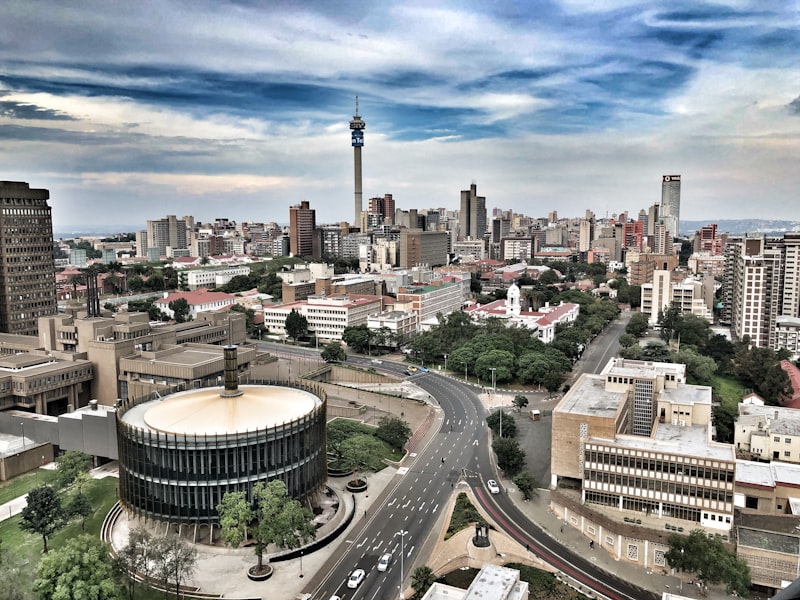
Gateway with Guardrails: Challenges Facing Institutional Investors in South Africa’s Derivative Markets
South Africa occupies a unique position in the African financial landscape. Home to the Johannesburg Stock Exchange (JSE) — the largest and most liquid stock exchange on the continent — and a well-developed regulatory framework overseen by the Financial Sector Conduct Authority (FSCA) and the Prudential Authority, it is the natural entry point for institutional investors seeking derivative exposure to African markets.
Yet sophistication does not equal simplicity. Institutional investors — whether pension funds, asset managers, hedge funds, or foreign portfolio investors — routinely face distinct challenges when accessing South Africa’s derivative markets. Understanding these challenges is essential for designing effective investment and risk management strategies.
R22tn+
JSE Market Cap (ZAR)
~85%
African Derivative Volume
3rd
Largest EM Exchange
1995
Derivatives Market Est.
The South African Derivative Landscape
The JSE operates one of the most comprehensive derivative platforms in the emerging market world. Through its Equity Derivatives Market, Interest Rate and Currency Derivatives Market, and the formerly separate SAFEX agricultural derivatives platform, institutional investors can access futures and options on equities, indices, interest rates, currencies, and commodities — all within a single exchange-regulated framework.
The rand (ZAR) is among the most actively traded emerging market currencies globally, with deep spot and forward markets complemented by exchange-traded and OTC options. The South African government bond market provides a liquid underlying for interest rate derivatives, including bond futures and overnight indexed swaps, referenced to ZARONIA — the rand’s Risk-Free Rate, following the global LIBOR transition.
Despite this depth, institutional investors consistently identify a cluster of structural and operational challenges that distinguish the South African derivative market from its developed market counterparts.
“The JSE gives you the infrastructure. But navigating the regulatory requirements, currency volatility, and liquidity gaps in the options market is far more demanding than the headline numbers suggest.”
Challenge 1: Regulatory Complexity and Capital Requirements
Challenge 01 — Regulatory
Navigating a Multi-Layered Regulatory Framework
South Africa’s derivative markets are governed by multiple overlapping regulatory bodies and frameworks, creating a complex compliance environment for institutional investors — particularly foreign institutions accessing the market for the first time.
The Financial Markets Act (FMA) of 2012 established the foundational framework for South Africa’s derivative markets, introducing requirements for trade reporting, central clearing, and market conduct. The subsequent Financial Sector Regulation Act (FSRA) of 2017 created the Twin Peaks regulatory model, splitting oversight between the FSCA (market conduct) and the Prudential Authority (prudential supervision).
For institutional investors, this creates several compliance burdens. OTC derivative transactions must be reported to a licensed Trade Repository. Certain standardized OTC derivatives are subject to mandatory central clearing through a licensed Central Counterparty (CCP). Foreign institutions must navigate both South African requirements and their home jurisdiction obligations — a dual compliance burden that can be especially demanding for EU-regulated entities subject to EMIR.
The South African Reserve Bank (SARB) also imposes exchange control regulations that affect capital flows. While South Africa has progressively liberalized its exchange control framework — most recently through the introduction of the Capital Flow Management system — residual restrictions on cross-border collateral arrangements and margin calls can create friction for foreign institutional participants in OTC derivative markets.
Challenge 2: Rand Volatility and Hedging Costs
Challenge 02 — Market Risk
The Double-Edged Sword of Rand Volatility
The South African rand is one of the most volatile major emerging market currencies, driven by a complex mix of domestic and global factors that make hedging both essential and expensive.
The rand’s notorious sensitivity to global risk sentiment — it is frequently described as a “risk-on/risk-off” currency — means that institutional portfolios with ZAR exposure can experience dramatic mark-to-market swings that are entirely disconnected from underlying South African fundamentals. A deterioration in US-China trade relations, a Federal Reserve hawkish surprise, or a spike in global risk aversion can drive rand depreciation of 5–10% within days.
Domestically, the rand is further pressured by structural factors including chronic electricity supply constraints (load shedding), elevated public debt levels, labor market rigidities, and political uncertainty. The currency’s high beta to commodity prices, particularly platinum group metals, adds another layer of volatility.
For institutional investors, hedging this volatility through the ZAR options market is possible but costly. The implied volatility surface for ZAR options carries a persistent upside skew reflecting the market’s chronic fear of rand depreciation. Rolling a three-month at-the-money put option hedge on a ZAR-denominated portfolio can cost 3–6% per annum in premium — a significant drag on returns that must be weighed against the cost of remaining unhedged.
Market Data — ZAR Derivative Costs (Indicative)
3-Month ATM Implied Volatility:14–20% (rising to 25%+ during stress events)
Annual Cost of Rolling Put Hedge: Approximately 3–6% of notional
Bid-Offer Spread (OTC ZAR Options):0.5–1.5 vols for standard tenors
ZAR/USD Forward Points (3M): Reflect ~5–7% interest rate differential
Challenge 3: Equity Derivative Liquidity Concentration
Challenge 03 — Liquidity
A Market Dominated by a Handful of Names
While the JSE offers derivatives on a broad range of underlying equities and indices, meaningful liquidity is concentrated in a very small number of instruments — creating significant challenges for institutional investors seeking exposure beyond the top tier.
The JSE Top 40 index futures and options account for the overwhelming majority of equity derivative volumes. Single-stock futures and options on mid- and small-cap JSE-listed companies are technically available but practically illiquid — bid-offer spreads are wide, open interest is thin, and large institutional block trades can move markets significantly.
This liquidity concentration creates several problems for institutional investors. Portfolio hedging strategies must be approximated using index instruments rather than single-stock overlays, introducing basis risk between the hedge and the underlying portfolio. Execution of large derivative positions — particularly options blocks — frequently requires negotiating directly with a market maker rather than accessing exchange-traded liquidity, reintroducing counterparty risk.
Furthermore, the JSE’s equity derivatives market is increasingly influenced by high-frequency trading, which can create short-term liquidity illusions — apparent depth in the order book that evaporates rapidly when institutional-sized orders arrive.
Challenge 4: Interest Rate Derivative Market Transition
Challenge 04 — Structural
The JIBAR-to-ZARONIA Transition
South Africa’s interest rate derivative market is in the midst of a transition from JIBAR (Johannesburg Interbank Average Rate) to ZARONIA (South African Rand Overnight Index Average), creating basis risk and documentation uncertainty for institutional participants.
The global shift away from IBORs has had significant implications for South African interest rate derivative markets. JIBAR, which has underpinned the majority of South African floating rate instruments and interest rate swaps for decades, is being phased out in favor of ZARONIA — a near risk-free, transaction-based overnight rate administered by the SARB.
For institutional investors with existing JIBAR-referenced derivative portfolios, the transition introduces basis risk between legacy JIBAR positions and new ZARONIA-referenced hedges. ISDA fallback provisions provide some protection, but the timing of JIBAR cessation and the precise fallback methodology remain sources of uncertainty. Institutions must actively manage their transition exposure, engage with counterparties on protocol adherence, and update their risk management systems — all of which require significant operational investment.
Challenge 5: Counterparty and Clearing Infrastructure
Challenge 05 — Operational
Limited Clearing Members and CCP Access
South Africa’s central clearing infrastructure, while improving, remains limited in terms of the number of clearing members and the range of products subject to mandatory clearing — creating concentration risk and access barriers for smaller institutional investors.
JSE Clear serves as the central counterparty for JSE-listed derivative products. For OTC derivatives, the market relies on a small number of major bank clearing members — primarily the large South African banks (Standard Bank, FirstRand, Absa, Nedbank) and a handful of international bank branches. This concentration means that the failure or withdrawal of a single clearing member could significantly disrupt market access.
Foreign institutional investors who are not direct clearing members must access clearing through a South African clearing member, which adds costs, operational complexity, and a layer of counterparty exposure. The collateral requirements associated with central clearing, particularly initial margin under SIMM (Standard Initial Margin Model) methodology, can also be significant for large institutional portfolios.
Challenge 6: Tax and Legal Framework Uncertainty
South Africa’s tax treatment of derivative instruments has historically been a source of uncertainty for institutional investors. The Income Tax Act provisions governing derivative taxation — particularly the distinction between revenue and capital treatment — have been subject to ongoing interpretation and amendment. For foreign institutional investors, the interaction between South African withholding taxes, double taxation agreements, and home jurisdiction tax treatment of derivative gains adds further complexity.
Legal enforceability of netting arrangements under ISDA Master Agreements has been confirmed in South Africa, providing important protections for OTC derivative counterparties. However, the enforceability of close-out netting in South African insolvency proceedings — while generally accepted — has not been tested in the Constitutional Court, leaving a residual legal risk that sophisticated institutional investors must factor into their counterparty risk assessments.
Navigating the Challenges: Practical Recommendations
Despite these challenges, South Africa remains by far the most accessible and liquid derivative market on the African continent. Institutional investors who invest in understanding the market’s specific characteristics can position themselves to access genuine return opportunities while managing risks effectively.
Establishing dedicated South African legal and compliance counsel is essential before entering the OTC derivative market. Engaging with multiple clearing members to avoid single-point-of-failure risk is advisable. Incorporating ZAR volatility costs into return projections from the outset — rather than treating hedging as an afterthought — is critical for realistic performance assessment. And monitoring the JIBAR-to-ZARONIA transition timeline closely will be necessary for all institutions with existing interest rate derivative exposure.
South Africa’s derivative markets reward preparation and penalize complacency. For the institutional investor willing to invest the time to understand the landscape, the gateway remains open — guardrails and all.
This article is part of a three-part series on institutional investor challenges in African derivative markets. Part 2 covers Nigeria; Part 3 covers the rest of Africa. Content is for informational purposes only and does not constitute investment advice.